

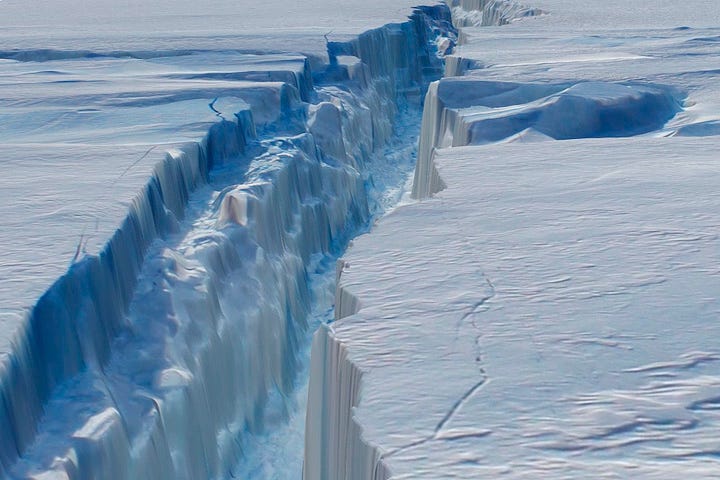
Professor Jennifer Krauss is the world’s leading synthetic biologist, having revived aready a woolly mammoth frozen within a glacier for more than ten thousand years, so when billionaires prospecting for rare earth minerals beneath melting polar ice discover a perfectly preserved Neanderthal family, Krauss is forced to try and revive them too.
This is the premise of A Crack In The Ice, a love story and tech thriller I started writing some years ago, but have so far left unfinished. I’ve returned to it of late, stimulated by US sabre rattling about Greenland, and by this amazing new mapping of the Antarctic.
The EO Wilson quote from the subtitle above is the guiding spirit of the so-far unfinished story. The ‘God-like’ in Wilson’s quote is a bit high-pitched, but otherwise I find it one fair encapsulation of our human predicament.
Please use the comments below to tell me what you think.
Thanks for reading.
Craig
(Image: NASA, wiki commons)

Chapter One:
Emma is waiting for me in the car park. ‘You’re late,’ she says.
I am. I look at her. She’s gorgeous. She’s unbelievable.
‘Open,’ I tell the pool car nearest to us. It knows my voice and releases and we hop inside.
Not ten seconds in our seats when Emma makes the first attack. Must have been rehearsed.
‘If you could have had kids yourself, Mum, why did you and Dad adopt me?’
She is by nature merciless, but my daughter’s sixteenth birthday has emboldened her to ask these crushing personal questions.
We’re heading away from the city’s medieval centre towards the private enclave of tech money on the west side of town. I’m taking Emma, the birthday girl, to her dad’s.
‘Why though, Mum?’
I blank her inquisition, hide inside mothering. ‘Did you pack your medicine?’
‘I’ve got spare medicine at Dad’s.’ I can hear her smiling, ‘I’ve got spare everything. I’ve even got a spare Mum.’
It’s both a joke and a barb. I’ll run with the joke. ‘Can you tell your spare Mum there’s a stack of laundry needs doing at home.’
‘We have a cleaner at home.’
‘I work to pay them.’
‘You’re rich.’
I am. It’s true. Well off, at least. As the university’s most feted intellectual, I’m certainly paid well. Though not as well as her father. But who is? He’s sold every gift he’s ever been given.
Husky light slants into the car. I look out of the windows as we drive. Our old European town isn’t yet submerged like many others. There’s a queue by the roadside. Agitated people snake from the doors of a Distribution Centre. But why so many?
Emma doesn’t notice. She fiddles with the dongle that Doug gave her to open his compound gates – the keys to his kingdom.
‘Why no breeding, Mum? You and Dad were young, you were in love, I guess?’
‘We were in love, yes.’
‘Why wouldn’t you make a mini-me?’
‘You sound like your father.’
‘And you sound like my mother.’
‘Touché.’
She’s so sharp, so clever. How am I ever going to keep up with her?
‘So, Mum?’
‘Look, it was me. My fault. My decision. My weirdness.’
‘You’re not adding to my information bank here. Tell me, really. I can take it.’
I turn my head, look right at Emma.
Was she right? Could she take it?
Let’s try her out.
‘I was carrying your father. Emotionally, intellectually, financially. I loved him, but he was drunk. He wanted kids, loads of them he said, running everywhere, hanging from treehouses.’
‘That’s what he has now.’
‘Yes.’
Doug’s second wife’s been more accommodating. It hasn’t helped Doug deal with his loneliness though, which is his to keep forever.
‘But you didn’t want the kids and the treehouse thing?’
‘I was carrying him. I couldn’t carry his baby as well.’
‘Wow. Is that how you see it? A baby’s like a chore?’
‘Not a chore. A parasite, more technically.’
Her eyes widen. ‘Christ Mum, you were hardcore.’
I was – and little has changed in that regard – but I had my work, my research, and it was going to make all the difference, it was going to save the world. I didn’t want to be reduced to this womb thing, this bow-legged baby bag.
She peers at me for a while, then looks away. ‘I kind of admire you Mum, but I kind of hate you too – speaking strictly as a parasite, of course.’
‘You were never a parasite Emma, you were a…’
‘I was a what, Mum?’ Her gaze is burning up my face.
‘Nothing.’
She clenches her hand in a fist around the dongle, almost bangs that fist against the car door. But she controls. ‘I was a what, Mum?’
I see that I have to tell her. Besides, I hate dishonesty. ‘You weren’t a parasite. You were a compromise.’
Our eyes meet for a second before she looks away. Raw emotion burns inside her. I’ve hurt her. I’m expecting a tantrum but it doesn’t come. Instead just silence, a heavy one.
I look beyond her turned head and out of the window. The falling light. The roadside trees, readying to turn. Another agitated queue outside another DC. Why’s everyone collecting at the same time?
We turn right onto a private road and Emma broadcasts passcodes to open the enclave gates. Inside, where compounds ring ostentatious houses, we drive along towards Emma’s dad’s house, a few hundred square metres bigger than the drafty University apartment she and I share.
Emma loves coming here, she’s told me, the bustle, noise, and people – unlike home with its knocking pipes and creaking boards, and her mother’s closed, tense face.
The car pulls up and she’s on the kerb already, her hand on the car door, itching to slam it shut. ‘Call me when you’re ready,’ I say. ‘I’ll come and get you.’
She looks back into the car, defiant. ‘Dad will want to drop me back.’
This toughness of hers will be gold for her in later life. But right now, I just wish it wasn’t aimed at me. ‘No, I’ll come and get you.’
‘Mum, I haven’t spent a birthday with Dad in ten years.’
‘Eleven.’
‘I get an extra half hour with him if he drops me home.’
‘Tell your Dad…’
Emma’s eyes widen. ‘Come on Mum, compromise.’
She has me, as always. All I can do is laugh. I can’t admit how terrifying I find Doug’s company, how harsh the light his presence shines on my emotional poverty, my choices, my failure to find my peace. But Emma can’t know this.
‘Okay. Tell Doug to drop you home. And ask him up for a drink, if he wants.’
For this I get a kiss. ‘Thanks, Mum.’
Emma swings closed the car door and I watch her approach the house, rising high behind the gates, lanterned usually by squares of light from the bedrooms of Emma’s half-brothers and half-sisters, but dark now, with just one room ablaze in the falling gloom, one light from the crow’s nest of Doug’s study, as inside he buys and sells, outsources, and reassigns. It’s just as his message said, Doug’s new wife and kids all away, with just him and Emma alone for a birthday treat.
Emma strides towards the compound gates, which recognise her and open to admit her.
I’ve never been in.
He wanted a breeder but I was a reader.
The gates reach their broadest swing then tip back closed as Emma passes inside.
*
My name is Professor Jennifer Krauss and I am two distinct things.
On the outside, I am a world expert on synthetic biology and paleogenomics. It was me who brought the mammoth back to life. But that tawdry show was just for funding, with no long-term public benefit, and the poor thing – Malcolm – died again soon after, in Stuttgart.
More importantly, but less showbusinessly, I am the first female President of the Royal Society in its 350-year history, and the second female President of the National Academy of Science. I have received the Centre National de la Recherche Scientifique’s Médaille d’Or and the Shanti Swarup Bhatnagar Prize for Science and Technology. I have lectured the Chinese Academy of Science and disproved the orthodoxies of umpteen bumptious laureates.
I am, as they say, the bomb.
If you look at me you will see all this. Everyone does. My dazzle claims the eye. But what is not seen – what has never been seen by anyone but Doug, who understood me and whom I chose to leave – is that inside I tremble.
I sit and I tremble at the kerb. My arm fidgets in its sling. The ache is deep. I look at the high, closed gates. I should go to the Faculty to supervise Edwin my protégé, but the thought of his subservient eyes makes me tired. So I sit and I stare at the gates. And then, from behind them, I hear my daughter’s voice.
‘Mum.’
The voice again – ‘Mum!’ – from behind the gates.
She’s left something in the car, or she wants to say some last smart cutting thing. But then again there’s something wrong here isn’t there. I step from the car, walk forward.
‘Mum!’ The voice is close, scared, just the other side of the gates.
‘Mum! Mum!’
Suddenly I’m ripped on maternal adrenaline. ‘Open the gates.’
‘I can’t.’
‘Use the thing.’
‘I dropped it.’
‘Get it.’
‘I can’t… Mum, get in here.’
I pelt to the gates with the notion of scaling them, but even panic won’t haul me up.
‘Mum. Now!’
‘Get Doug.’
‘Now!’
Her terror is pure and real.
I look up at the high gates, glance back at the car. I sprint back to the road, get in the car, start it.
…I roar to the gates, smash them through, tear it off the hinges…
Of course I don’t. Because I can’t, can I? Emma’s there.
I climb out. ‘Get away from the gates. Get away… Are you away?’
‘Yes. Hurry.’
I jump in, flip the controls to manual, pop my arm from its sling, back up, scream forward towards the gates, right foot heavy on the pedal.
…Sounds and shapes and tearing metal…
My body jags forward against the wheel, then I’m shoved back, pinned in my seat by the detonating air bag – white balloon palming up against my face, arm throbbing.
I hear a clang and a hiss. Emma screams, ‘Mum!’
I fight sideways from behind the bag, fall from the car, crunk hands then knees onto pavement. Look down, - shit – see my gunshot cut has opened. Pain but no matter, no time for pain. I drag my eyes from the cut, aim them down the wing of the car towards the gates.
No. No! They still stand.
…But not wholly intact though.
One of the gates is angled, leaning forward slightly at the top, off a bottom hinge. I crawl towards the front of the car, slide into the gap between the bumper and the gates, wriggle through to see a small opening at the bottom, a triangular hole where the gate’s tilted.
Madly, I squirm towards it, push my head through, my neck and shoulders, grazing myself, hurting myself. The arm of my jumper wet with blood. Emma stands inside by the side of the drive, mute now, crying. I tear myself fully through the hole, run to her. My lips kiss her hair, my arm’s round her back.
‘What…Baby? What?’
She takes my good hand and pulls me to the house, Doug’s money mansion, all the edges he’s found and markets he’s gamed glommed into this dazzling hutch. I look up to the lights of his study, blazing through the dusk.
‘What, Emma?’
She just turns to me and stares.
She stumbles, drags, marches us towards the open front door.
I’m inside Doug’s house for the first time, a blur of old furniture and new art as she hauls me through, away from the main staircase and over to a smaller one. Up she drags. Heart booming; breath short.
‘What? What?’
No answer.
Up the stairs. She is sobbing, sobbing.
We come to a landing and there is the dongle, dropped on the plush carpet by a doorway. The door’s open. The sound of rolling news comes from inside, a TV presenter talking about the Dow and the FTSE and the Dow Jones, talking about ‘economic terror,’ about ‘unprecedented crash.’
Ah, so that’s why the Distribution Centres were mobbed.
Some steps from the doorway, Emma stops moving. She’s reluctant, mute. She points into the room. She drags me close to her then shoves me away, aiming me towards the room.
Okay. Right. It seems I’m going in.
I step forward. I can see inside now, the vast TV screen on the far wall of Doug’s study, the clamour of falling numbers, plunging graphs, the shocked presenter intoning fiscal apocalypse.
Behind me, I hear Emma whimper.
I’m through the door now, eyes moving from the blahing screen over to the leather desk – the wrapped birthday present for Emma on the desktop, the drained decanter of Scotch.
I’m fully in the room.
My eye catches something strange, the tip of a shoe, a simple, classic brogue, nothing unusual, except it’s in the air. It’s next to another shoe, also in the air, shining, clean, and above the shoes are legs and a torso and a puce neck, yanked sideways by the belt tied around it which is hung from the roof beam.
Doug hangs dead before me, a chair kicked away behind him, his fancy shoes dangling before my eyes, our girl Emma behind me, hiding from the sight she alone discovered, as the TV chatters on.
Strong opening chapter. The protagonist's internal conflict about ambition vs. connection feels really authentic, especially the 'parasite' line which is harsh but honest in a way that fiction often avoids. I've worked with folks in hard sciences and that tension between carrer demands and personal life is relentless, making the final scene hit even harder.