

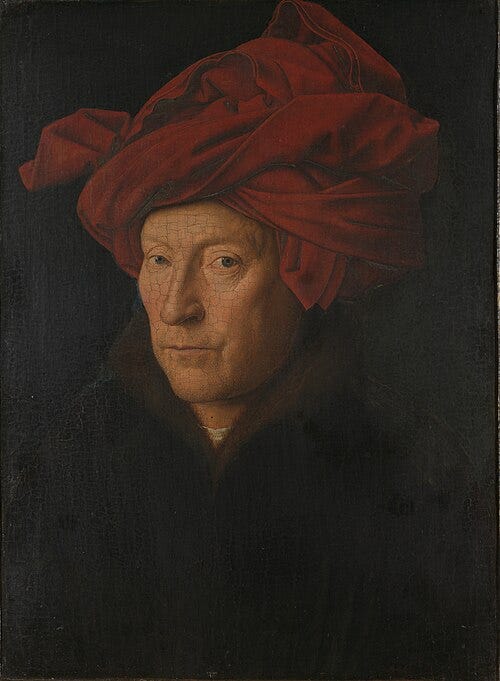
Picture: Jan van Eyck, Portrait of a Man (Self Portrait?)
Life is being comical. These two things are true:
As a university student I was accurately described by a lecturer as, ‘the most anti-academic student I’ve ever met.’
Nowadays, I’m an academic.
How did this happen? Is it some form of self-hatred?
Well, no. The lecturer mentioned above taught anthropological theory, whereas I work on vocational degrees (in publishing, media and journalism) where we use real industry experience to teach practical, creative and critical skills.
I’m still almost as conflicted about the academy as I was as an undergraduate. I mean, it’s no wild coincidence that one use of the word academic is to denote things which are literally beside the point: ‘not of practical relevance; of only theoretical interest.’
Q: What do you do?
A: Oh, I produce things of no practical relevance.
Great. Have a load of my taxes
Honestly, when I think about the amount of obtuse mental onanism that goes on in universities in the name of ‘research’, well it’s the nearest I ever get to being a Tory. Because I’m not sure that repeating complicated pay-walled opinions that nobody understands should in all honesty be a viable publicly funded career. It offends my practical Northern heart.
Anyway, I’m in danger of being beside the point here. The point being that now there is a third thing which is also true.
This is the third thing: I’ve started a PhD.
I’m no spring chicken. It took a long time to find a subject and a supervisor that allowed me to write directly and honestly about my experience, without the addition of extraneous academic stylings. It took me ages to find a way to (show and) tell the truth. But I think I might be there.
I’m doing a PhD in literature at The University of Antwerp with Professor Dirk van Hulle, who is a major dude. Finish this PhD and I’ll officially be a doctor in de letterkunde. This is pleasing. Those who know me will know my abiding love for Belgium. It’s a PhD through practice, which basically for me means that you do a thing and then relate how you did the thing, so that other people can hopefully learn a bit about doing their things too.
To rewind a bit, between the years 2015 and 2018 I worked on a project with the British Library where they installed a piece of spyware on my computer to record every single keystroke I made in the writing of my novel Staying On. Then, the British Library released that data into the wild via their servers on a free-to-use creative commons licence, so that people who were interested in the creative process would have some stuff to play with.
It was fun. If you want, you can read about it here and here.
At the time I didn’t understand why, but most of the interest in using the British Library data to look at the nature of the creative process came from Belgium. Then, some years later, I did understand why it came from Belgium, because I met Professor Dirk van Hulle in Oxford.
In 2024 there was a brilliant exhibition in Oxford called Write Cut Rewrite which showed a load of the Bodleian Library’s draft manuscript collection, the versions and doubts and agonies that writers went through to get to the finished end of some very famous books.
And I thought YEAH! This is how you understand things. By looking at the grief and pain and circumstances of the author - sweating the work, feeding the kids, tending a parent, taxing the car - and not by ideologically grilling the finished text to locate the author as the patsy of the corrupt historical tendency that you’re personally invested in exposing.
Oops. As you’ll gather from the way that last sentence ended, I was peeved with literary criticism telling me why a load of the writers I liked were crooked conduits and I wanted a way instead to understand and respect their toil a little more. As someone said on here recently, (apologies, I forget who) the work by some in English Literature departments to reclassify great works of literature as being politically suspect is surely at least partially to blame in the dwindling prospects of those self-same English Literature departments.
I mean: Behold the wonders of English Literature, loads of it’s dodgy is not the most magnetic pitch for cash-shy parents and kids.
Again, I’m heading off the point, am grinding my own axe truth be told, whilst also criticising other people for grinding their axes - like some kind of human being.
I’m far from wholly innocent here and far from wholly right. As a beleaguered author of course I liked the approach that empathised with the beleaguering of the author. But honestly, I also thought it was the best approach and after years of authors being variously dead and/or suspect, I wanted, as I say, to respect the craft and toil.
In short, I loved this focus on the act of creation in the Write Cut Rewrite exhibition and so I wrote to the organiser - Professor van Hulle - to tell him so. We met up and got on and it turns out he’s the world lord of a thing called Genetic Criticism, which is in one way basically locating the meaning of the text in the process of its creation, and which is... big in Belgium. So solving the little mystery of the Lowlands-centred British Library data craze.
Dirk explained that there was better software now than the clunky spyware I’d used for the British Library thing - a project he’d heard of before. This new software was specifically designed by some dudes at the University of Antwerp and it could yield richer fruit. Fruit data. Data fruit.
So, Dirk and I decided to run the British Library experiment again, but with this new software and last year when I wrote the novel As Best I Can - rather handily set in contemporary Belgium and concerning the work of my hero (above) the 15th century Flemish painter Jan van Eyck - we recorded the entire process by installing Flemish widgets on my laptop.
This recording has subsequently became the cornerstone of my PhD through practice, another part of which also involves documenting the practical strategies of a creative process. Meaning that after a dozen odd years of teaching in one way or another in Higher Education, below, tardily, is the opening of my very first academic paper, first published in July in a journal called Textual Cultures.
It is a paper designed to be of practical relevance; it is written in language designed to be understood; it is not pay-walled, and it aims to help people to do things. It’s written in short by an anti-academic academic.
More than Reading: Using Libraries to Develop Stories
The single most significant written work in my professional development as a novelist is not a novel, or even a work about fiction, but rather a cheesy-sounding book on the craft of screenplays by Dara Marks called Inside Story: The Power of the Transformational Arc (A&C Black, 2009).
Ostensibly, Marks may seem to fit with the clamorous ranks of contemporary story gurus offering novice writers the secret to mastering the art of the screenplay via online courses, set-piece workshops, zoom mentoring, and other alchemical acts of transmuting writerly hope into hard cash (an activity known in the publishing industry as ‘monetising the slush pile’) but she is far more than that.
Any canonical sweep of the body of knowledge relating to the craft of screenwriting must begin with mention of Aristotle’s Poetics as the necessary (though quite often unread) pagan antecedent to the true craft. While Syd Field’s Screenplay, The Foundations of Screenwriting (Dell Publishing 1979) and George Lucas’s starry 1970s devotion to Joseph Campbell’s work of comparative mythology The Hero With A Thousand Faces (Pantheon Books, 1949) form non-negotiable aspects of the Old Testament, the New Testament must itself include Robert Mckee’s Story: Substance, Structure, Style and the Principles of Screenwriting (Regan Books, 1997) and Blake Snyder’s declarative, self-marketing Save the Cat! The Last Book on Screenwriting You’ll Ever Need (Michael Wiese Productions, 2005). While a rare non-North American late entry, John Yorke’s Into the Woods: How Stories Work and Why We Tell Them (Penguin Books, 2014), has quickly become prevalent for those wishing to both structure story around midpoint and match their output to existent genres of scripted television.
Having taught such texts on the craft of screenwriting in creative writing situations in both the private sector and in higher education settings, I have witnessed that their guidance relating to story structure is often felt to be constraining and stipulative by those writers mostly concerned with developing a novelistic practice, especially when the story craft guidance centres on getting the ‘right moments’ in the ‘right order’. Certainly, this seems right if we were to bulk import screenwriting craft practice straight across into novelistic practice…
To carry on reading, download the paper for free here.
===
I’ve been remiss, have not written on here for a while. I’ve been busy working on things which I hope soon to be able to reveal. And summer of course was a bit to blame for the silence; summer which turned my leafy English village as yellow as Arles, and summer in which I deliriously saw five stone-cold masterpieces of world art. Things I’ll write about on here anon.
===
Finally, because above I’m writing about the university, I feel beholden to mention the death of Professor Jason Arday.
I’ve read everything on here about his life and death, from the left and the right, from the mean and the kind, the devastated and the bitter, and all I can say right now is bless his kids.
It is hard for me to provide words on things which have really affected me. The facility is not mine. It took me ten years to write about the murder of my friend Jo Cox. I’ve not yet been able to frame a single word about the heroic Gisèle Pelicot, and if I’ve ever anything to say about Jason Arday, it’s unlikely to be this decade.
For now: Bless your kids, Professor Jason Arday. Bless your wife and kids.
Hi Craig
Thank you for your post and for the link to your article. Looking at forgery, you might find this interesting: B.A. Shapiro, 'The Art Forger' which reimagines the Isabella Stewart Gardner heist. A parallel true story is Michael Finkel, 'The Art Thief'. Good luck with your doctorate.
Jennifer Harris (Retreat West 2020-21)